













No results found. Try different filters.
Turkey
7
NDA
Entertainment
Java/Kotlin
Ant Media Server packaged a Java-based media stack that aimed to remove the heavy lifting of real-time streaming infrastructure: ingestion, protocol translation, state sync, recording, and global delivery. Operators installed AMS on cloud or on-prem nodes (or via marketplace images), used the web admin panel and REST APIs for management, and integrated client SDKs into apps and web players to publish/subscribe low-latency streams. The product line included an open-source Community edition and an Enterprise edition with clustering, autoscaling and commercial support for production deployments. Documentation, examples and case studies accompanied the product to accelerate adoption.

Scaling WebRTC at volume
Scaling large WebRTC audiences (thousands–tens of thousands of viewers) demanded clustering, regional routing and load-testing strategies.

Protocol & device fragmentation
Supporting many ingest/playback protocols and device capabilities (browsers, mobile, hardware encoders) created complexity in transcoding, fallback and codec negotiation.

Enterprise integration & protocols (WHIP/SRT)
Adding modern ingestion standards (WHIP) and reliable transport (SRT) while keeping backward compatibility with RTMP/RTSP increased integration and testing scope.
We optimized Ant Media deployments for ultra-low latency by tuning WebRTC buffers, adaptive bitrate logic and client fallbacks so interactive use cases (auctions, telehealth) had sub-second responsiveness. We built a robust ingestion/transcoding layer and added WHIP/SRT support so diverse encoders and hardware could stream reliably. We designed and deployed autoscaling Kubernetes clusters and regional routing to reach thousands of concurrent viewers while keeping latency low. Finally, we hardened the Java runtime and added observability and SDK wrappers so engineering teams could operate the platform in production with predictable SLAs.
1. Ultra-low latency WebRTC
Ant Media delivered WebRTC-based streaming with sub-0.5 second end-to-end latency for one-to-many and many-to-many scenarios, enabling highly interactive experiences.
2. Multi-protocol ingest & playback
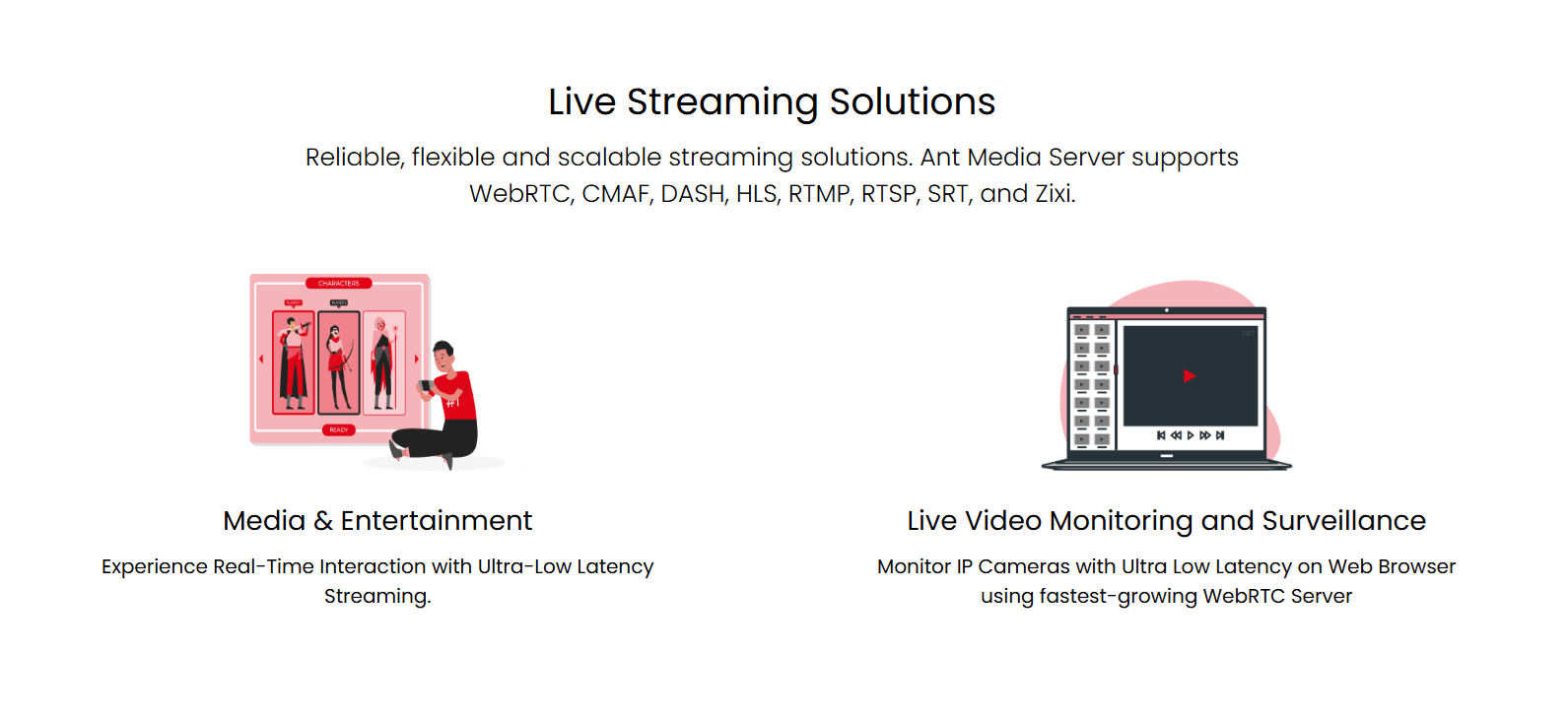
The server supported RTMP/RTSP/SRT/Zixi ingestion and could deliver streams via WebRTC, LL-HLS/LL-DASH (CMAF) and standard HLS/DASH for broad device compatibility.
3. Clustering & autoscaling
Ant Media provided cluster support and autoscaling patterns so deployments could scale publishers and viewers horizontally for large events.
4. Recording & VoD
The platform recorded live feeds (MP4/HLS) and offered on-demand playback workflows and adaptive bitrate rendition generation.
5. SDKs & client integrations
The vendor shipped native SDKs (Android, iOS) and cross-platform SDKs (Flutter, React Native) plus REST APIs and sample apps to accelerate developer integrations.
The solution improved user engagement, and a pilot adoption rate exceeding expectations.
Deployments that used these solutions reduced end-to-end latency to sub-second ranges in interactive scenarios, which improved user engagement and enabled real-time features (bids, remote assistance). Protocol and SDK work increased source compatibility and reduced integration time for partners by weeks. Autoscaling clusters and JVM hardening lowered incident rates during peak events and cut operational MTTR. Together these improvements raised live-event reliability, viewer retention, and enabled new revenue streams for customers (paid live events, telehealth consultations, live commerce).
© All rights reserved. ApiceFlow LIMITED